
The issue of foreign nationals marrying South African women for immigration purposes has once again come under the spotlight, after a Laudium woman approached the Laudium Sun with a string of serious concerns about her failed marriage to a Pakistani national.
Bianca Berrios Espinoza, a resident of Bengal Street, Laudium, told the Laudium Sun that she wanted to share her story so that other women could be ‘saved’ from being used by foreigners who enter into relationships and marriages for the purpose of securing longer stays in the country.

Pakistani national Muhib Ullah Bhatt of Bangladesh Heights, who works as a bookkeeper at a local cellular shop, is now in the spotlight, but not for a heroic reason, rather over allegations of fraud, manipulating the Home Affairs Temporary Residence Permit (TRP) system, abusing his former wife and marrying her to obtain a permit.
Bianca put pen to paper and then approached the Laudium Sun, saying, “I am writing to formally report a number of events and concerns arising from my relationship with my former husband, Muhib Ullah, and to request assistance in investigating and resolving these matters. My concerns include threats, emotional and verbal abuse, financial hardship, concerns regarding immigration documentation and my Temporary Residence Permit (TRP), my displacement from accommodation, and a vehicle that was purchased in my name. I have retained records that I believe may support my concerns, including correspondence, recordings, invoices, messages and other relevant documentation relating to dealings involving the cellular shop he works at. I am also concerned that my marriage may have been entered into under false pretence, as it seems it was only done by him for immigration purposes. I did not sign a spousal agreement and, to my knowledge, the marriage was not registered with Home Affairs. This statement reflects my recollection of events. Where information was provided to me by another person, I have identified it accordingly. I am willing to provide supporting records and clarify dates where necessary. I met Muhib in February 2023, and our Nikkah took place on March 12, 2023. Before the Nikkah, my representative asked Muhib whether he was legally present in South Africa. Muhib said that he was and showed us his passport. Based on this assurance, my representative agreed to represent me at the Nikkah. I entered the marriage in good faith because I wanted to build a stable family home and a positive relationship between Muhib and my son, Ahmed. My mother passed away on March 24, 2023, shortly after the Nikkah. Muhib told me that I could mourn for only three days and I was not allowed to attend her funeral. My family’s disapproval of the marriage further complicated the situation and I felt unsupported during my bereavement and conversion to Islam. We moved to 242 Bengal Street, Bangladesh Heights, Unit 32, Block 9, Laudium. My understanding was that the premises belonged to Q&A Cellular. To my knowledge, Muhib worked at Q&A Cellular and he also worked for Ejenti Tents. My understanding was that he earned approximately R75,000 per month from that employment. His employment and income can be verified against the relevant records. During the first year of our marriage, Muhib repeatedly criticised and mocked my son, Ahmed, who was approximately eight years old. For example, if Ahmed ate two rotis, he was reprimanded and told that he would become fat. I paid Ahmed’s school fees as he attended a local Muslim school, contributed towards domestic help and paid my own business expenses. When Muhib assisted me financially, I repaid him because he told me that he was a poor man. I did not marry Muhib for financial gain. I wanted a supportive family environment for my son. As the situation deteriorated, I felt it would be safer for Ahmed to live with his biological father during 2024. Being separated from my son caused me considerable distress. Towards the end of 2024, Muhib agreed that Ahmed could return, after seeing how seriously the separation had affected me. I experienced repeated criticism over ordinary purchases. On one occasion, Muhib called me wasteful when I asked for a packet of peanuts while he was purchasing gifts for relatives in Pakistan. When we bought household groceries, he selected the food, and I had to ask permission for anything I wanted. I was called ‘shameless’ and ‘wasteful’ and I eventually began purchasing food with my own money. I also paid for outings with my daughter and items such as flowers for the garden. Muhib purchased clothing for me from Pakistan because he disapproved of the clothing I wore, including black abayas that I had bought in South Africa. I consulted a local doctor and explained what was happening. I was prescribed medication for my emotional well being and sleep. My mental health continued to deteriorate, and I experienced difficulty functioning, episodes of breathlessness and severe distress. I now associate this distress with the emotional pressure, verbal abuse and prolonged silence I experienced. Muhib told me to obtain employment. I secured a position offering approximately R60,000 per month. However, after my first day, he read the contract and told me that I could not continue because it involved approximately 280 working hours per month. I also found documents indicating that he had been purchasing properties in Pakistan. When I asked why these purchases had not been discussed with me, I did not receive an explanation. Muhib issued the first talaq following a disagreement about how I cleaned the bathroom. I had emptied the cleaning water into the toilet and washed my hands in the kitchen afterwards. He issued a second talaq after I requested assistance with an ESP Group truck that was stuck at the border. My driver was ill with malaria and COVID-19, and I had to arrange assistance. Muhib subsequently apologised and accompanied me to the border after I asked to use the vehicle purchased in my name. A third talaq was later issued. I need to confirm the precise date against the written statement and correspondence, because my recollection of the sequence requires clarification. In approximately October 2024, a friend who had lent us furniture sold it to an employee. When I asked whether I could buy replacement furniture, Muhib refused, saying that the property was not our ‘forever home’. This added to my uncertainty about our future. Throughout the relationship, I repeatedly asked when our marriage would be registered in South Africa. Muhib told me that I needed to sign a document at the VFS office, which I did. I require assistance in obtaining that document and establishing its purpose. I later found documentation relating to a permit involving another woman. When I questioned Muhib, he told me that he paid her R500 per month and said that I should consider myself lucky because he could easily find someone else to do the same. This caused me serious concern about whether our relationship had been used for immigration purposes. SA Immigration subsequently informed me that my details were linked to a TRP arrangement that allowed him to work in South Africa, and that a company had been opened in which I was listed as a worker. I request independent verification of this information. I reported the divorce to an immigration official in Benoni, whose name I recall as Michael Odendaal. I understood him to question Muhib’s immigration status. I was also informed of an incident in which Muhib was removed from, or prevented from boarding, a flight to Pakistan. These details require confirmation from official records. I found passports and Pakistani divorce documents that raised further questions. I could not identify South African entry stamps in the documents I examined. I am not qualified to determine their legal significance and therefore request an official review. In February 2025, I experienced a serious mental-health crisis during a period of severe emotional distress. At that stage, I believed that I had been used and could not obtain clarity about the marriage or my legal and financial position. In March 2025, my usual medication was unavailable in Laudium, and I obtained a generic alternative from Benoni. On March 16, 2025, Muhib left the shared home and removed items he had purchased. During this incident, I felt humiliated and provoked in front of the staff accompanying him. I acknowledge that I slapped him during the confrontation. I asked for a meeting with a moulana and my attorney to document arrangements concerning the vehicle and allow him to take responsibility for it properly. He threw the keys towards me and left. I was given approximately two hours to vacate the premises. I left without adequate funds or stable employment while studying towards my traditional healing accreditation. With assistance from my Apa, I moved to Actonville. I could not immediately secure a school placement for Ahmed, and he was out of school for approximately two months.

“I contacted a government school in Laudium about Ahmed returning to school, and the school agreed. I asked Muhib to assist with Ahmed while I stayed in Johannesburg and tried to earn enough to support us. To my recollection, Muhib provided limited assistance, including approximately R3,000 after contact from the landlord. Muhib later asked me to return to Laudium, saying that he would help me get back on my feet and that I was too far away for him to assist if anything happened to me. I believed these assurances and returned. He then visited regularly, including in the mornings and on Thursdays and we resumed intimacy. I told him that because we were divorced, we needed to remarry. He refused. In October 2025, I was told to vacate the Laudium premises because the property had allegedly been sold. This caused further disruption to Ahmed’s schooling. He only secured a school placement around June or July 2026. Aniss from Q&A Cellular told me that I had to leave because rent had not been paid and that they could not reach Muhib. However, in June 2026, a mutual acquaintance told me that my former sister-in-law, Tamana, was residing at those premises. I request clarification regarding the ownership, occupancy and rental arrangements. My attempts to obtain answers and closure have repeatedly resulted in communication being blocked. I have also approached religious leaders but have not obtained a resolution to the outstanding matters. A vehicle that Muhib wanted was purchased in my name. I felt pressured to agree to the purchase, and the banking obligation remains associated with me. Payments were not maintained following our separation, leaving me concerned about debt and possible damage to my credit record. I respectfully request assistance with the following matters: assessing the threats and advising on appropriate protection for me and my family; establishing the legal status and consequences of the Nikkah and subsequent talaq statements; reviewing immigration applications, permits and documents involving my name or signature; verifying any company or employment records in which I am listed; establishing responsibility for the vehicle, its finance agreement and unpaid instalments; reviewing the circumstances surrounding my removal from the Laudium premises; identifying the appropriate authorities to investigate any irregularities supported by the evidence; and advising me on how to securely submit my supporting documents, recordings, messages and financial records. These events have had a serious effect on my well-being, finances, housing and my son’s education. I delayed pursuing these matters because I struggled to cope, but I now need a lawful and documented resolution. In 2023, I met my former husband, Muhib Ullah, and entered our Nikkah in good faith. Before the marriage, my representative asked why he was in South Africa and whether his immigration status was lawful. I believe the assurances given to us were false, based on the evidence and supporting documents I have submitted for investigation. I have grieved the relationship I believed I had and the future I hoped we would share. My priority now is to resolve the outstanding immigration matter and protect my rights. I am requesting the immediate removal of my name and details as the spouse or supporting partner linked to his Temporary Residence Permit (TRP), with written confirmation from Home Affairs. My requests remain unresolved, and I have escalated the matter through the relevant channels, seeking an urgent investigation into why my details remain linked to the permit. Muhib must address his immigration position directly with Home Affairs and the relevant authorities. I do not consent to any continued reliance on my name or our former relationship to support his immigration status. My message to women is to ask questions, seek independent verification and understand any documents before signing them. Religious assurances should not replace independent advice about marriage, finances or immigration arrangements. South African law governs legal and immigration matters in this country. The applicable rules and procedures must be followed, and women deserve clear information, accountability and protection of their rights. I am willing to provide the relevant supporting documentation and cooperate with any authorised investigation.”
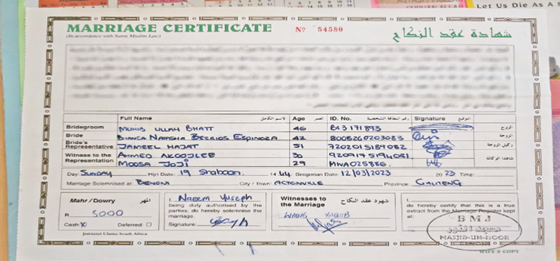
The Laudium Sun contacted Muhib Ullah from Bangladesh Heights, who denied all the allegations made by his former wife, Bianca.
Certain statements of Bianca’s letter were removed by the editor, which were regarded as sensitive, to protect the complainant in this matter.
Bianca has given the Laudium Sun permission to print her letter, with the hope that someone in the relevant government department or a private investigator would be able to assist her with regards to her concerns, as outlined in the letter.
The Laudium Sun will also, through our attorney, copy this letter to the relevant security departments.