
It is unfortunate that there are some in our midst, who will go to any lengths, even in the name of religion, to scam others. It seems that there is an increase in the number of local residents being pointed out as fraudsters or scammers, conning whoever they can to make some quick money as more and more complaints are received by the Laudium Sun.
In one of the most recent complaints received, a number of Muslims have complained of being scammed after paying for sheep for qurbani, which they say they never received. Complaints have also been received from livestock traders, who claim that they have not been paid for livestock deliveries for qurbani. The individuals said that they lost thousands of rand, which they saved over months, in order to perform the important religious ritual of sacrifice during the sacred period of Hajj. The livestock traders who have complained allege that they lost huge sums of money after a flock of sheep meant for qurbani were collected but not paid for. Fingers have been pointed towards Jameel Hassim, who is believed to be living in Hava Gardens in Erasmia, near Laudium. Many alleged that he promised to provide sheep for qurbani, at lower prices, which he apparently never delivered. Many of those complaining allege that Jameel falsely claimed that he had a farm in Erasmia and bred various breed of livestock, including sheep and goats and also bred chickens and that he had been supplying meat to businesses and religious organizations for years, locally and beyond. Now many disgruntled people have alleged that although they had paid upfront for sheep for the recent qurbani period, they are still to receive it, despite the said period of sacrifice already having passed, about a month back.

Local livestock trader, Mohamed Ridwaan Vallee of the nearby Eldoglen Security Estate, who trades from a farm in the nearby Valhalla area, alleged to the Laudium Sun, “Jameel Hassim approached me approximately four weeks before qurbani to purchase livestock, claiming that he was reselling on a mass scale and could not get enough supply. He arrived in a new Haval P-Series bakkie with a livestock trailer, which in our industry is usually a sign
of a serious livestock trader. Jameel also presented himself as a decent, hardworking Muslim man and often brought his son, Muhammed, who he introduced as an accountant. This further created the impression to me of a trustworthy, hardworking person, simply trying to make a living. Jameel took his first load of livestock and paid in cash. The following day, he returned for another load and claimed that he had sold out within hours. He then said that some of the money his customers had paid him for the livestock, had not cleared into his account and that he could only cover 75% of the invoice, promising to pay the balance later in the evening or once the funds cleared, as he was being paid from a different bank account. I documented his FICA details before he left, and both he and his son assured me that they would not mislead me, especially since I had assisted them. I did not supply him with amounts exceeding the value of his livestock trailer, in case anything went wrong, so that I could recover losses if needed. However, Jameel did pay as promised for the second load and later claimed he was short of specific sheep sizes, returning for another load under the same arrangement. Over time, Jameel showed strong interest in other products we sell, including chickens from my abattoir, and stated that he would be purchasing in large quantities as he also trades in poultry. He even shared pictures of his facility, which further supported the impression that he had the capacity to conduct larger business after qurbani. Over the course of the four-week period, trust was built, and he began taking stock on consignment, paying as he sold. About a week before the period of qurbani, he required a large amount of stock and began collecting almost daily, claiming that most of his clients would pay on the day of qurbani, which is common practice in the trade. He further stated that he would make full payment after qurbani, as his daughter had been admitted to hospital and he was unable to collect payments at the time. Jameel took most amount of the stock in the week leading up to qurbani on the promise that the account would be settled in full the Monday after the three day qurbani period. However, his attitude changed and he began giving various explanations, including claims that he was robbed of cash and that his facility had burned down. He provided pictures and case numbers to support these claims. However, I was later forwarded a message in a livestock traders’ group warning that he had allegedly defrauded several farmers, which raised further concern. I then visited his premises on a plot near Erasmia and recovered some assets, valued at approximately 10% of what was owed, as that was all that could be found. I also gave him an opportunity to respond, during which he claimed he was securing a loan to settle the outstanding amount, which did not materialise. After conducting my own inquiries along with checking social media posts, it appears that Jameel has been involved in similar ‘schemes’ within the livestock industry over a number of years, leaving other farmers also short changed for their money. It is further alleged that he builds trust with suppliers, takes small quantities of livestock, pays for it in cash but then takes larger quantities on credit once trust is established, and then fails to pay, offering various excuses. It is also claimed that he mentioned previously working as a Sheriff of the Court, which may have helped him gain trust in business dealings. There are also various posts circulating on social media alleging similar misconduct, including incidents involving horses and other livestock. These are serious allegations within the farming community, and anyone approached for business dealings is advised to exercise caution and conduct proper verification. Any affected parties are reportedly encouraged to contact the relevant law authorities or livestock theft units for further assistance.”

Mohamed Amin Mota of Lavender Livestock in Bon Accord, Pretoria, told the Laudium Sun, “I run a business known as ‘Lavender Livestock’ and Jameel Hassim came to me and requested livestock worth R40,000. The transaction was done on 24 May 2025. At the time, the deal appeared to be straightforward and based on mutual understanding within normal business practice. Jameel presented himself as someone actively involved in livestock trading and indicated that he required the stock urgently. The livestock was accordingly supplied based on the agreement that payment would be made as discussed between both parties. However, after the transaction was completed, the outstanding balance was not settled. Despite repeated attempts from my side to request payment, there was no response from his side regarding payment of the outstanding amount. Initially, there were several assurances made that the payment would be made shortly, but as time passed, these commitments were not fulfilled. I made several follow-up attempts to recover the money, including direct communication and reminders, as is normally done in business when payments are delayed. Unfortunately, these efforts did not result in the settlement of the outstanding balance. In any business environment, trust plays a major role, especially in the livestock trade where transactions often depend on agreed credit terms and timely payments. In this case, the expectation was that the agreement would be honoured as per normal practice, but that did not happen. The situation has placed financial strain on my business, as the R40,000 involved is a significant amount that impacts cash flow and operational planning. Small and medium livestock businesses rely heavily on timely payments to continue functioning, purchasing new stock and meeting ongoing expenses. At this stage, I am still seeking a resolution and hoping that the matter can be resolved amicably without further escalation. However, the repeated delays and lack of payment have made the situation increasingly difficult. I believe it is important that such
matters are addressed properly within the business community to ensure fairness and accountability in all transactions. My intention remains to recover the outstanding amount and close this matter in a professional manner.”
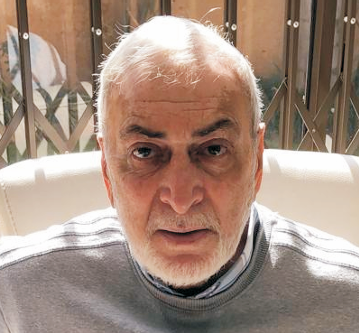
Munira Cassim of Raslouw, told the Laudium Sun, “I am reaching out to the Laudium Sun because my family and I would like to share what we believe is a deeply distressing experience involving a livestock arrangement for qurbani during Eid al-Adha 2026. My family and I paid R75,000 to Mr Jameel Hassim for Qurbani, the religious sacrifice performed during Eid al-Adha. As the going rate of a sheep was around R3500, Jameel quoted us a bulk price of R75k for 40 sheep, amounting to a price of around R1900 each, including to cut and clean so we took up his offer. We were promised by Jameel that the sheep would be delivered from the Sunday onwards prior to the day of Eid, at his farm in Erasmia and arrangements were made for our entire family to come to his farm on Eid day to spend the day there and witness the sheep being scarified on each of our names, relying on these assurances in good faith. As the days passed, we repeatedly followed up with him, Jameel eventually sent us a pin location to a farm near Erasmia where we were led to believe the sheep were located. However, when we arrived, there were no sheep and we were informed that the farm did not belong to him. Thereafter, communication became increasingly difficult. His cellphone was frequently switched off and despite repeated attempts to contact him, to finalise the Eid day arrangements and to check why the sheep were not delivered, there was no response from him. As a result, our family was unable to perform our Qurbani for Eid, which was extremely heartbreaking and distressing for us, both emotionally and spiritually. This is not simply a financial loss. It affected an important religious obligation and moment for our family. What has added to our concern is that, following this incident, we became aware of a Facebook post from last year in which allegations were reportedly made involving a poultry-related matter connected to Mr Hassim. While we cannot verify those claims ourselves, given our experience, we believe this background may warrant further investigation and public scrutiny. We have payment proof, messages, call records, the pin location sent to us, and other supporting information relating to this matter. We are sharing our experience because we do not want other families to go through what we have experienced, particularly during such an important religious occasion. We have laid a complaint at the police station and would appreciate it, if you would consider looking into and covering this matter in the public interest.”
Shortly before going to press, the Laudium Sun received more complaints against Jameel, which we were not able to add onto this story, due to time constraints.
The Laudium Sun attempted to contact Jameel Hassim for comment, even sending a message via his cellphone to contact us regarding the allegations made against him. However, there has been no feedback from him.
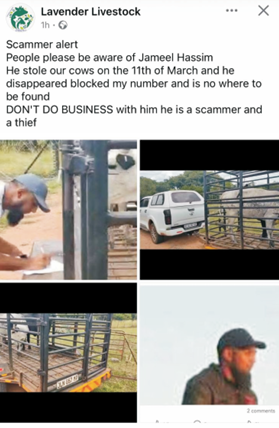
Mota, owner of Lavender Livestock, of
Jameel Hassim who apparently collected cows from the farm without paying for it.