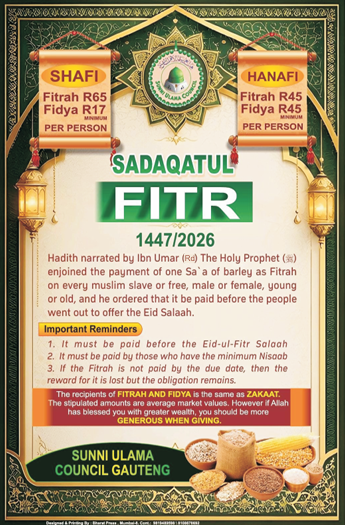
Narrated by Ibn Umar (RA): Allah’s Apostle (peace be upon him) enjoined the payment of one Sa’ of dates or one Sa’ of barley as Sadaqah-tul-Fitr on every Muslim, whether slave or free, male or female, young or old. He also ordered that it be paid before the people went out to offer the Eid prayer (Sahih Al-Bukhari, Vol. 2, Book 25, Hadith 579).
“Fast Remains Suspended“
Sayyiduna Anas bin Malik (RA) reports that the Prophet of mankind, the peace of our hearts and minds, the most generous and kind (peace and blessings be upon him) said: “Man’s fast remains suspended (between the earth and sky) unless Sadaqah-e-Fitr is paid.” (Kanz-ul-Ummal, Vol. 8, Hadith 24124).
A few points points on Fitrah.
1.Paying Sadaqah-e-Fitr is Wajib (compulsory) for every Muslim man and woman who is Sahib-e-Nisab, provided their basic necessities of life are excluded from their wealth calculation (Fatawa Alamgiri, Vol. 1).
2. A Sahib-e-Nisab is a person who possesses 7.5 tolas (one tola equals 11.664 grams) of gold or 52.5 tolas of silver, excluding basic necessities.
3. Sanity and puberty are not conditions for Sadaqah-e-Fitr to become compulsory. If a child or an insane person is Sahib-e-Nisab, their guardian should pay Sadaqah-e-Fitr from their wealth on their behalf (Rad-dul-Muhtar, Vol. 3). Although the Nisab amount for Sadaqah-e-Fitr is the same as that of Zakah, there is no requirement for wealth to increase or for a full year to pass. If a person owns items beyond their basic needs, such as household goods not in daily use, and their value reaches the Nisab amount, then Sadaqah-e-Fitr becomes compulsory (Waqar-ul-Fatawa, Vol. 2). This difference between the Nisab of Zakah and Sadaqah-e-Fitr depends on the financial condition of the individual.
4. In addition to paying his own Sadaqah-e-Fitr, a Sahib-e-Nisab man must also pay on behalf of his minor children. If he has an insane child, he must also pay on their behalf even if the child has reached puberty. However, if such children are themselves Sahib-e-Nisab, the payment may be made from their own wealth (Fatawa Alamgiri, Vol. 1).
5. It is not Wajib for a Sahib-e-Nisab man to pay the Fitrah for his wife, parents, younger brothers and sisters and other relatives. (Fatawa ‘Alamgiri, pp. 193, vol. 1)
6. In the case of a father’s demise, it is Wajib for the grandfather to pay Sadaqah-e-Fitr for his poor orphaned grandchildren (Durr-e-Mukhtar, Rad-ul-Muhtar).
7. It is not Wajib for a mother to pay Sadaqah-e-Fitr on behalf of her young children (Rad-dul-Muhtar)
8. It is not Wajib for a father to pay the Sadaqah-e-Fitr for his sane and adult offspring (Durr-e-Mukhtar, Rad-dul Muhtar, pp. 317, vol. 3)
9. If somebody did not fast in Ramadan either due to any valid exemption or, Allah Azzawajal forbid, without valid reason, Sadaqah-e-Fitr will still be Wajib for him provided he is Sahib-e-Nisab. (Rad-dul Mukhtar, pp. 315, vol. 3)
10. Sadaqah-e-Fitr will be valid if a man pays it on behalf of his wife or adult offspring (whose necessities like food, clothing etc. he is responsible for) even without their permission. However, if he is not responsible for their necessities, for example, he has a married son who lives in his own home along with his family and affords his expenses himself (food, clothing etc), then paying Fitrah on behalf of such offspring without his permission will not be valid.
11. If a wife pays her husband’s Fitrah without his order, it will be invalid. (Bahar e-Shari’at, pp. 69, part. 5)
12. Sadaqah-e-Fitr is Wajib for every such Muslim who is Sahib-e-Nisab at the time of Subh-e-Sadiq (dawn) on the day of Eid-ul Fitr. If someone becomes Sahib-e-Nisab after Subh-e-Sadiq it is not Wajib for him to pay the Fitrah. (Fatawa ‘Alamgiri, pp. 192, vol. 1)
13. Though the preferable time for paying Sadaqah-e-Fitr is that it be paid on Eid after Subh-e-Sadiq before offering Eid Salah, if it is paid on the night of Eid (before Subh-e
Sadiq) or any day during Ramadan or even before Ramadan it will still be valid. All these cases are permissible. (Fatawa ‘Alamgiri, pp. 192, vol. 1)
14. If the day of Eid passed and somebody did not pay the Fitrah, the Fitrah will not lapse on this account. Fitrah will be considered valid whenever it is paid in the whole life. (ibid)
15. Sadaqah-e-Fitr can be spent only where Zakah can be spent. In other words, Fitrah can be given to only those whom Zakah can be given to. (Fatawa ‘Alamgiri, pp194. Vol. 1)
16. It is not permissible to give Sadaqah-e Fitr to the honourable descendants of the Holy Prophet Sallal Laahu Alaihi Wasallam. Amount of Sadaqah-e-Fitr 1.920 kilograms of wheat or its flour or the money equivalent to the value of this much wheat is the amount of one Sadaqah-e-Fitr.
According to one narration, whoever recites “SubhanAllahi wa bi hamdihi” 300 times on the day of Eid and then sends the reward to the souls of deceased Muslims thousand Nur will enter the grave of every Muslim. Further, when the reciter dies, a thousand Nur will enter his grave as well. (This can be recited on both Eids). (Mukashafa-tul-Qulub, p. 308)
A Sunnah Before Eid Salah
Acts that are Sunnah on the occasion of both Eid (Eid-ul-Fitr and Eid-ul-Adha)- Sayyiduna Buraidah (Radi Allahu Ta’ala Anhu) states, “On the day of Eid-ul Fitr, the Holy Prophet (Sallal Laahu Alaihi Wasallam) would go to offer Eid Salah after eating something while, on Eid-ul-Adha, he (Sallal Laahu Alaihi Wasallam) would not eat anything unless he (Sallal Laahu Alaihi Wasallam) had offered Eid Salah” (Jami’ Tirmizi, pp. 70, vol. 2, Hadith 542)- Similarly, in Bukhari, there is another Hadith narrated by Sayyiduna Anas (Radi Allahu Ta’ala Anhu), “On the day of Eid-ul Fitr, the Beloved and Blessed Prophet (Sallal Laahu Alaihi Wasallam) would not go until he (Sallal Laahu Alaihi Wasallam) ate a few dates in odd numbers.” (Sahih Bukhari, pp. 328, vol. 1, Hadith 953)- It is narrated by Sayyiduna Abu Hurairah (Radi Allahu Ta’ala Anhu) that the Holy Prophet (Sallal Laahu Alaihi Wasallam) would go to offer Eid Salah from one path and would return from the other one. (Jami Tirmizi, pp. 69, vol. 2, Hadith 541)
Method of Offering Eid Salah (Hanafi)
First make the following intention: ‘I intend to offer two Rak’at Salah of Eid-ul-Fitr (or Eid-ul-Adha) with six additional Takbirat, for the sake of Allah Azzawajal following this Imaam.’
Having made the intention, raise the hands up to the ears, utter Allahu Akbar and then fold the hands below the navel and recite the Sana. Then raise your hands to your ears, utter Allahu Akbar and leave them at sides; then raise to ears again, utter Allahu Akbar and leave them at sides; then raise hands to ears once again, utter Allahu Akbar and fold them. In short, hands will be folded after first and fourth Takbir while they will be left at sides after second and third Takbir. In other words, hands will be folded when something is to be recited in Qiyam after Takbir, while they will be left at sides when nothing is to be recited. (Derived from Durr-e-Mukhtar, Rad-dul-Muhtar, pp 66, vol. 3). Then, the Imaam is to recite
Ta’awwuz and Tasmiyyah in low voice whereas Surah Fatiha and another Surah will be recited loudly. Thereafter, he will perform Ruku’. In the second Rak’at, the Imaam is to first recite Surah Fatiha and another Surah aloud.
After the recitation, the Imaam as well as all the Muqtadis (followers) will utter three Takbirat (the Imaam would utter loudly and the followers in low voice) raising their hands to the ears each time and leaving them at sides. Then Ruku’ will be performed with the fourth Takbir without raising hands and the rest of the Salah will be completed as per usual method. Standing silent between every two Takbirat for the amount of time in which SubhanAllah can be uttered thrice is necessary.’ (Fatawa-e Alamgiri, 1982, pp. 150, vol. 1)
What to do if somebody misses a part of Eid Jama’at
If someone joins the Jama’at in the first Rak’at after the Imaam had uttered the Takbirat, he should utter the three Takbirat (other than the Takbir-e-Tahrimah) instantly, even if the Imaam may have commenced recitation. Utter three Takbirat only, even though the Imaam said more than three Takbirat. If the Imaam bent for Ruku’ before you uttered Takbirat, then don’t utter them in a standing posture, instead, perform Ruku’ with the Imaam and utter the Takbirat in the Ruku’. However, if the Imaam is in Ruku’ and you think that you can utter the Takbirat and join the Imaam in Ruku’, then utter them whilst you are standing, otherwise, utter Allahu Akbar, perform Ruku’ and then utter the Takbirat in Ruku’. If the Imaam raises his head from Ruku’ before you finish the Takbirat in Ruku’ then do not utter the remaining Takbirat; they are no longer required.
If you joined the Jama’at after the Imaam had performed the Ruku’ then do not utter the Takbirat, utter them when you offer the remaining part of your Salah (after the Imaam has performed Salam). Do not raise your hands when uttering the missed Takbirat in Ruku’.
If you joined the Jama’at in the second Rak’at, then don’t utter the missed Takbirat of the first Rak’at now, instead, utter them when you perform the remaining part of your Salah. Likewise, if you succeed in uttering the Takbirat of the second Rak’at with the Imaam, its all right, otherwise, the same ruling as mentioned above with regard to the first Rak’at would apply. (Derived from Durr-e-Mukhtar & Rad-dul-Muhtar, pp.55, 56, 57, vol. 3)
What to do if someone misses the whole Jama’at?
If someone missed the whole Jama’at of Eid Salah, whether he couldn’t join the Jama’at at all or his Salah became invalid due to any reason after joining, then if possible, he should join Jama’at elsewhere; otherwise he cannot offer it (without Jama’at). However, it is preferable for him to offer four Rak’at of Chasht Salah. (Durr-e-Mukhtar, pp. 58. 59, vol. 3)
May Almighty Allah, forgive our sins, accept all our good deeds and grant us understanding of Deen. Aameen. We would like to wish one and all a very blessed Eid Mubarak