
AL JAMA-AH WARD CANDIDATE – FAIZEL JAPPIE
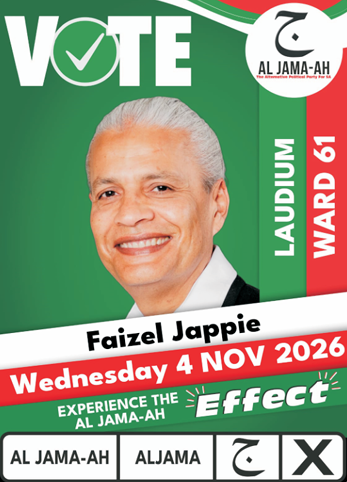
I would like to express my sincere gratitude to the Laudium Women’s Network for the honour of inviting me to participate as a panellist at the Ward 61 Election Panel Discussion on Saturday, 24 October 2026.
Representing Al Jama-ah as a candidate ward councillor, I presented key elements of our municipal manifesto. What emerged from the discussion was a fundamental question: Are we prepared to confront the reality of Ward 61, or will we continue to vote on sentiment while our infrastructure deteriorates?
Let us put emotion aside and examine the issues.
1. WATER: WHERE IS THE INFRASTRUCTURE INVESTMENT?
I raised the lack of new water infrastructure in Laudium during my lifetime of observation.
Cllr Patel maintained that multiple reservoirs feed Laudium and that the problem is Rand Water throttling supply rather than a local water infrastructure shortage. However, publicly available information appears to indicate a more limited local reservoir and feeder arrangement.
These are technical questions that demand technical answers.
Where are the infrastructure assessments? What is the actual capacity of the supply system? What are the peak-demand figures? What investment has been made, and what is planned to accommodate population growth?
Residents do not need political assurances. They need verifiable engineering facts and a funded plan.
2. SEWERAGE: GROWTH WITHOUT CAPACITY IS A RECIPE FOR FAILURE.
Itireleng was not part of the original town planning footprint in the way that subsequent population growth has demanded. Backyard accommodation has expanded, and residential development has increased across the area, including Erasmia.
As Pastor Marian recalled, Itireleng was once a scrapyard when he was growing up. It is now a suburb.
The question is not whether communities grow. The question is whether municipal planning keeps pace with that growth.
Every additional household places demands on water supply, sewerage, electricity, roads and waste management.
What goes in must come out. If sewerage infrastructure cannot accommodate the population it serves, the consequences are inevitable.
Where is the capacity assessment for the existing sewer network? What is the plan for upgrading it? Who is accountable for ensuring that residential growth does not become a public-health crisis?
We cannot keep adding people to an infrastructure system without asking whether that system can sustain them.
3. ELECTRICITY: WHERE IS THE CAPACITY FOR TOMORROW?
I raised the absence of new substations in Laudium during the period I have observed.
I also recounted a troubling incident at the Claudius substation. During a transformer upgrade, newly delivered transformers were reportedly loaded onto heavy-duty trailers bearing Tshwane branding. According to my account, a tip-off from members of the public helped prevent their theft.
This is a serious allegation that deserves a proper investigation and transparent disclosure of the facts.
If public infrastructure can be placed at risk in this manner, residents deserve to know what happened, what safeguards were in place and what action followed.
Meanwhile, the bigger question remains: What is the municipality’s electricity infrastructure plan for a growing Ward 61?
Municipal service delivery requires more than political promises. It requires coordination between the relevant departments, technically sound assessments, realistic budgets and measurable implementation plans.
The municipality is responsible for providing and managing essential services within its jurisdiction, including water, sanitation, electricity where it is the service provider, refuse removal and municipal roads. The precise allocation of responsibility must be established for each issue.
The ward councillor’s role is to serve as the interface between residents and the municipality: raising concerns, engaging the relevant departments, requesting technical assessments, following up on complaints and holding the responsible officials accountable for their commitments.
This requires structured engagement with the relevant departmental officials to establish the facts, identify the solutions, determine budgetary requirements and agree on realistic implementation timelines.
Residents should not simply be told that a problem exists. They should be told which department is responsible, what action is proposed, what funding is required, who is responsible for implementation and when progress will be reported.
4. POLICING: RESIDENTS NEED ACTION, NOT DISMISSAL.
I recounted two occasions when, while driving through the White Blocks area, I approached police officers parked outside the station and questioned why visible patrols and proactive enforcement were not taking place.
I asked whether officers could conduct stop-and-search operations where legally justified or investigate suspected drug-dealing activity nearby. I say the officers responded by telling me to get lost.
If that is an accurate reflection of how a concerned resident is treated, it is unacceptable.
I was subsequently advised by a gentleman in the audience, whom I understood to be a Community Policing Forum (CPF) leader, that I should have followed protocol by approaching the Visible Policing (VISPOL) head or Station Commander.
Protocol has its place. But protocol must never become an excuse to dismiss legitimate concerns about community safety.
A further question deserves clarity: what are the applicable rules governing CPF leadership, political-party activity and conflicts of interest? Any concern should be assessed against the relevant rules and evidence, not assumptions about an individual’s affiliations.
Residents deserve a police service that responds professionally, acts lawfully and treats community concerns seriously.
The station commander manages the station with dedicated smaller sectors such as VISPOL and community engagements. CPF operates at police station level and is the gap between local communities and SAPS to address specific neighbourhood safety concerns. Does our CPF head know his mandate and is he executing his mandate? Is he actively engaging with SAPS on the matters of escalating crime?
5. HOUSING: WHERE IS THE PLAN?
Our Al Jama-ah manifesto addresses housing, supported by blueprint plans.
Cllr Patel dismissed our proposals. That is his prerogative. But dismissing an alternative is not the same as solving a housing shortage.
If Ward 61 faces a housing deficit, residents deserve to see the municipality’s housing strategy, delivery targets, land availability, funding commitments and implementation timelines.
If our proposals are flawed, let them be challenged on their technical and financial merits.
But where is the competing plan?
Political criticism is easy. Delivering homes is the test.
6. BUSINESSES: COMPLIANCE MUST BE ACCOMPANIED BY SOLUTIONS.
We also discussed the rezoning of properties used for business purposes. Some businesses have closed because the necessary land-use approvals were not in place.
My position is straightforward: where legally permissible, affected property owners should receive practical guidance and assistance in navigating the relevant approval processes.
At the same time, tenants must exercise due diligence before signing lease agreements. They should verify that the intended business use is lawful and that the necessary permissions are in place.
A municipality should enforce its bylaws fairly while helping residents understand how to comply with them.
We need lawful businesses, protected property owners, viable jobs and a municipality that makes compliance achievable rather than unnecessarily complicated.
7. THE PANEL: WHERE WAS THE SUBSTANCE?
The discussion sometimes felt more like a rehearsed political performance than a serious engagement with the challenges facing Ward 61.
I may not have the years of political experience of some of my fellow panellists. But political experience is not the same as integrity, competence or the ability to deliver.
I will not pretend that everything is working when residents are raising legitimate concerns. Nor will I sacrifice the interests of the community to protect political reputations.
I am standing for the residents of Ward 61, not for a political establishment.
I am not claiming that I can solve every problem overnight. I am saying that every problem must be confronted honestly, every proposal must be tested on its merits, and every commitment must be measured against actual delivery.
Every concerned raised by the community can be addressed by the relevant government authority.
8. WARD 61: YOUR VOTE IS YOUR FUTURE.
To the people of Ward 61, this election is about much more than party loyalty.
It is about the water coming out of your taps, the sewage leaving your homes, the electricity reaching your properties, the safety of your families, the availability of housing and the survival of local businesses.
The ANC that many of us once fought for is not the same ANC that governs today. History and loyalty deserve respect, but neither should exempt a political party from scrutiny.
The concerns raised by Ward 61 residents must not be dismissed as inevitable or unsolvable. Each concern should be referred to the government department or public authority responsible, investigated on its merits, and followed through to a documented response and, where action is required, a practical plan with defined responsibilities, funding considerations and implementation timelines.
Where the municipality lacks direct authority, the ward councillor must engage the appropriate provincial or national department or other responsible institution and keep residents informed of the outcome.
The objective is not merely to identify problems. It is to establish responsibility, secure action and report progress to the community.
If elected, I will advocate for a structured Ward 61 Service Delivery and Accountability Register.
The register would record the concerns raised by residents, the department or authority responsible, the date the matter was referred, the response received, the proposed corrective action, any identified budgetary constraints and the status of implementation.
Where matters remain unresolved, I will pursue them through the appropriate municipal structures and escalate them to the relevant provincial or national authorities where necessary.
Residents should be able to see what has been reported, who is dealing with it, what progress has been made and what remains outstanding.
I cannot promise that every problem will be resolved overnight. I can commit to pursuing legitimate concerns, demanding answers, reporting progress honestly and working towards measurable improvements. Ward 61 deserves a system of accountability, not another collection of election promises.
9. A FINAL WORD TO THE VOTER
To the lady in full purdah who called me a liar and asked where Al Jama-ah had been for the past 15 years, my answer is simple: we are here, and we are now taking an active interest in the future of Ward 61.
Judge me on what I say, what I propose, the evidence I produce and what I do if elected. Apply the same standard to every other candidate.
Do not give anyone a free pass because of their party, their history, their friendships or their promises.
And do not mistake political theatre for political performance.
When you stand before that ballot paper, open your mind. Examine the record. Question the promises. Demand the evidence.
Do not vote merely because your heart remembers what a party once stood for.
Vote according to what your brain tells you about what that party is delivering today.
Your vote is not a reward for past loyalty. It is a mandate for future performance.
Your children and grandchildren will inherit the consequences of the choices you make today.
Ward 61 does not need another political performance. It needs leadership that works, infrastructure that keeps pace with growth, and a councillor who answers to the people.
I am ready to stand for Ward 61, not as a political backbencher, but as a representative prepared to challenge, engage, demand answers and work for measurable improvement.
Think with your brain, not your heart. Your vote must serve your future, not somebody else’s political comfort.