
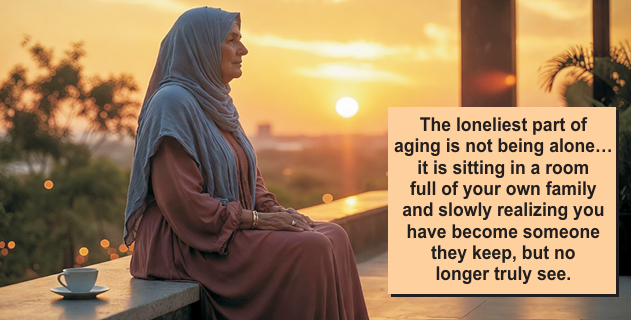
My name is Samina. I am seventy years old, and I have lived long enough to know that old age does not come quietly—it arrives with lessons you never thought you would have to learn.
The hardest of them all is this: the loneliest part of aging is not being alone… it is sitting in a room full of your own family and slowly realizing you have become someone they keep, but no longer truly see. I remember last Eid. The house was full—Alhamdulillah, full of life, full of noise, full of blessings.
The smell of biryani and sheer khurma filled the air, children ran from room to room, and laughter echoed through the walls. My sons were there, my daughters, and my daughters in-law—each busy in her role.
One was in the kitchen, managing everything with efficiency, giving instructions, making sure every dish was perfect.
Another was hosting, greeting guests with a warm smile, making tea, keeping the flow of conversation going. The youngest one was sitting with the children, trying to keep them entertained, occasionally glancing at her phone.
And I… I was placed on the comfortable chair in the corner.
“Ammi, you sit here… don’t worry about anything.”
They said it with love. I know they did. But sometimes love changes its shape.
From being needed… to being managed. I sat there watching them all, like a quiet observer in a world that once revolved around me.
Conversations flowed around me like a river flowing around a stone. I could hear everything, see everything… but I was no longer part of it.
At one point, my granddaughter sat just a few feet away from me, her fingers dancing across her phone. I smiled at her, waiting for her to look up.
When she did, it was only for a second—a polite smile, soft and distant—before she disappeared back into her little glowing world. In that moment, something settled heavily in my heart.
I had not become useless… but I had become invisible.
How strange life is. There was a time when this same house needed me for everything. My sons would not make a single decision without asking me.
My daughters-in-law would come to me for guidance—how to cook, how to manage the home, how to deal with children, how to handle life.
Now, they have learned everything… and perhaps they no longer feel they need to ask.
And this is where the test begins. Because in Islam, every stage of life is a Imtihan (test). Youth is a test. Marriage is a test. And old age… old age is a test of the heart.
I began to notice small things. They would discuss plans—holidays, gatherings, decisions—while I sat right there. No one would ask, “Ammi, what do you think?”
They would pass by me, gently placing a hand on my shoulder, “Are you okay?” And before I could even answer properly, they had moved on.
It was as if I had become something to check off a list.
Spoke to Ammi? Yes.
Gave her food? Yes.
Made sure she’s comfortable? Yes.
But no one asked… “Did we truly sit with
her?”
I do not blame my daughters-in-law. No. Each of them carries her own burdens.
Running a home is not easy. Being a wife, a mother—it takes strength. And I see their efforts. I make du’â for them every day. But sometimes, I wish they would sit beside me—not out of duty, but out of love. Not to serve me, but to hear me.
Because I am still here.
I still have stories.
I still have thoughts.
I still wake up with feelings, with dreams, with reflections of a life that the Almighty allowed me to live.
There were moments when I tried to speak.
“Do you remember when your husband was little, he once fell so sick—”
“Yes Ammi, you told us,” they would say with a smile.
But they don’t know the story. Not really. They only know the surface of it. They don’t know the nights I stayed awake making du’â, the Khauf (fear), the tawakkul, the tears I wiped
quietly so no one would see.They know the outline… but not the Qalb of it. After some time, I stopped trying. Sometimes they have to repeat things for me, a little louder, a little slower—and I see the flicker of irritation they try to hide. Under their breath, my sons or daughters-in law will whisper, “She’s not wearing her hearing aids again…” and I sit there quietly, hearing not just their words, but the weight behind them.
It is a strange kind of silence—the one you choose because speaking feels heavier than staying quiet.
But then one night, I sat alone and asked myself: “Ya Allah, is this how I will live the rest of my days? Present… but not present?”
And something shifted inside me.
I remembered that my worth is not defined by how much people include me. My worth is defined by my relationship with the Almighty.
He sees me.
He hears me.
He knows every word I do not say.
So I made a quiet decision.
I would not become bitter… but I would also not disappear.
The next gathering, when they guided me to my usual chair, I smiled… but later, I slowly got up and walked into the kitchen.
One of my daughters-in-law looked surprised.
“Ammi, you need something?”
I said gently, “No beta, I just came to sit with you.”
And I stayed.
At first, it was awkward. They didn’t know what to say. I didn’t know how to enter their fast-moving conversations. But slowly… slowly, something softened.
Another day, when my sons were discussing plans, I spoke.
“That sounds nice. I would like to come too,
Ameen.”
They paused. Looked at me. Then nodded.
It was small… but it mattered.
I also changed something within myself.
Instead of waiting to be asked, I began to share—small thoughts, small reflections, even things I was learning about my dîn. I told them about a reminder I heard, about sabr, about shukr, about how Rasulullah (SAW) valued elders and taught us to honor them.
Not to demand respect… but to remind with love.
Because this is also part of our Islam—that the young show mercy to the old, and the old show wisdom and patience to the young.
Old age is not the end of life.
It is a marhala (stage) where the Almighty gives you a different role.
Less doing… more reflecting.
Less noise… more du’â.
Less control… more tawakkul.
Yes, there is loneliness sometimes.
But there is also Qareeb (closeness) to the
Almighty that you never felt before.
So if you ask me today what old age feels like, I will tell you this:
It feels like standing at the edge of two worlds—one slowly letting go of you, and one quietly calling you back to your Creator.
And in between… you learn to find your voice again.
Not loud.
Not demanding.
But present. Because I am not just their past.
I am still a soul walking towards the
Almighty.